
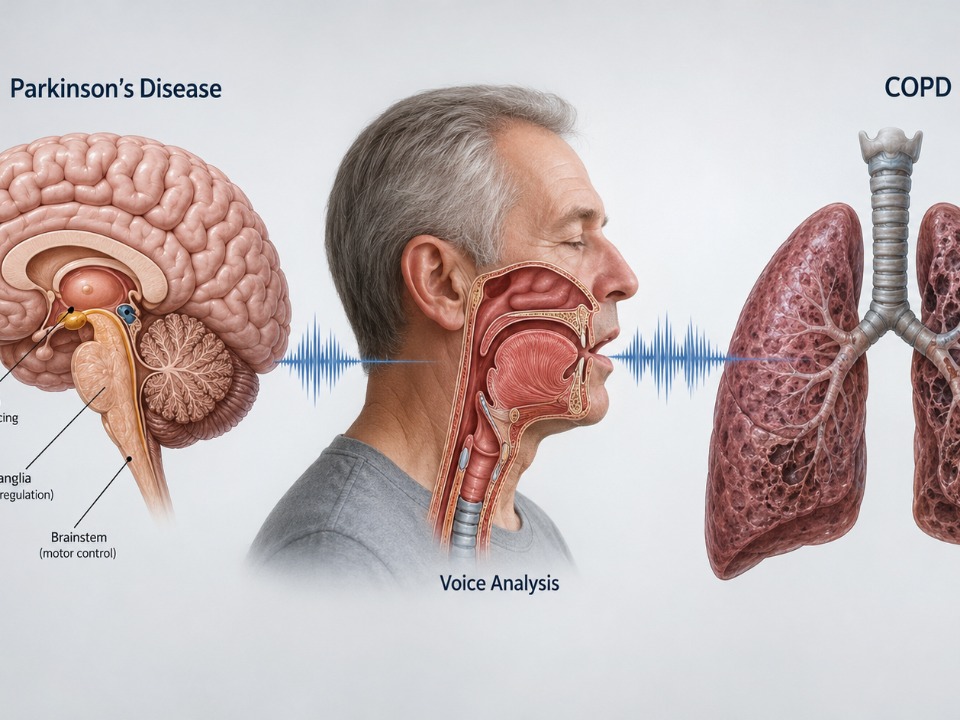
Use of machine learning and voice for multiclass classification of Parkinson’s disease, chronic obstructive pulmonary disease, and
- Post by: AHT
- 22 May, 2026
- No Comment
Authors: Alper Idrisoglu, Anders Behrens
Abstract:
Parkinson’s disease (PD) and chronic obstructive pulmonary disease (COPD) are prevalent conditions with substantial impact on quality of life and health care systems. Both disorders affect voice production through different physiological mechanisms, yet neither condition has a widely adopted objective biomarker for routine clinical use. Voice analysis has emerged as a non-invasive digital biomarker candidate, but existing studies have largely focused on binary classification within a single disorder or language. This study aimed to evaluate whether an unified multiclass machine learning (ML) framework applied to sustained vowel “a” phonation can discriminate between PD, COPD, and healthy controls (HC) across linguistically distinct cohorts. Sustained vowel recordings were analyzed from Swedish speaking individuals with COPD and HC, and English-speaking individuals with PD and HC, collected under comparable mobile recording conditions. Acoustic features included baseline voice measures and Mel Frequency Cepstral Coefficients. A soft voting ML framework integrating support vector machine, random forest, CatBoost, and light gradient boosting classifiers was trained using nested cross validation with hyperparameter optimization. Data were partitioned at the participant level into a development cohort and an independent test cohort. Model performance was evaluated using accuracy, macro averaged precision, recall, F1 score, receiver operating characteristic analysis, and confusion matrices. Model interpretability was assessed using Shapley additive explanations and vowel space analysis. The final soft voting classifier achieved robust multiclass discrimination on the participant disjoint independent test set, with an overall accuracy of 0.842 and a macro averaged F1 score of 0.839. Classification performance differed across groups, with the highest performance observed for PD, intermediate performance for HC, and lower performance for COPD. Misclassifications occurred primarily between HC and COPD, while confusion between PD and COPD was minimal. Feature attribution analysis revealed class dependent relevance patterns, and vowel space analysis demonstrated subtle but consistent group level differences. These findings demonstrate the feasibility of using an explainable soft voting machine learning framework applied to sustained vowel phonation to distinguish between neurologically and respiratory driven voice impairments across linguistic contexts. The study supports voice as a promising digital biomarker modality for multiclass clinical discrimination using mobile recordings.
Keywords: Parkinson’s disease, Chronic obstructive pulmonary disease, Voice analysis, Machine learning, Digital biomarkers, Multiclass classification, Explainable artificial intelligence
DOI: https://doi.org/10.1038/s41598-026-53409-3